Don't Learn Alone: 3 Research-Backed Reasons to Take Your Team With You
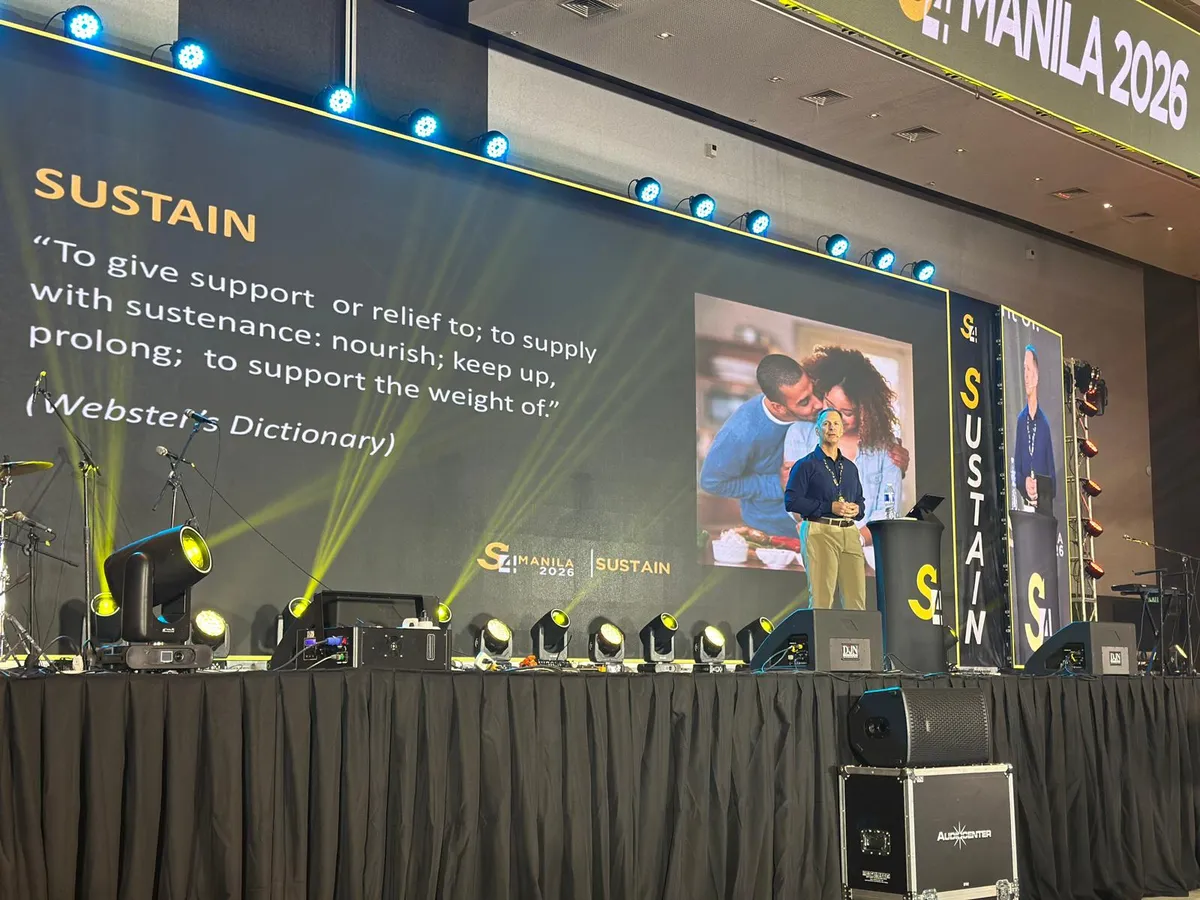
This week I had the honor of serving as one of the main speakers at the S4 conference in Manila. The picture in this post is from one of those sessions. I had the opportunity to speak on several occasions, and my wife was right there with me, serving alongside me every step of the way.
More than 1,000 people attended. It was electrifying. The purpose of the gathering was simple and powerful: to inspire pastors, missionaries, and other ministry leaders to keep advancing the gospel and to keep believing God for bigger and greater things.
Leaders from around the world came together to grow, to be encouraged, and to be sent back out stronger than they arrived. Next year, S4 moves to Africa for the third time, and I'm already looking forward to what God will do there.
I want to say something plainly before I go any further: I am deeply grateful. It is a privilege to serve teams and leaders around the globe, and I never take it lightly. Standing in front of that many leaders who have given their lives to serve others reminded me that the most meaningful work any of us do is helping people become who they were created to be.
But the thing that stayed with me most as I reflected on the week wasn't the stage. It was the people sitting together in the rows. I watched ministry teams arrive together, take notes together, pray together, and talk through ideas over meals. And I couldn't help asking a question that I think every leader, in ministry or business, needs to answer honestly:
When was the last time you took your team with you to learn?
I'm a firm believer in continuous learning. I've said it often: growth isn't optional for a leader. But the longer I lead, the more convinced I become that there's a difference between a leader who keeps learning and a leader who learns with their team. The first leader gets better. The second leader gets a better organization.
Below are three proven principles for why learning together synchronizes and strengthens a team. None of them were conducted at a conference, so I'll be honest about how far each finding stretches. But together they point to the same conclusion: if you want a stronger, more aligned team, don't just send them a summary of what you learned. Bring them with you.
Principle 1: Learning Together Builds Shared Knowledge of "Who Knows What"
Psychologists have a name for one of the most underrated ingredients of high-performing teams: the transactive memory system. The term was introduced by psychologist Daniel Wegner and colleagues in the 1980s, and it describes how members of a group collectively store, share, and retrieve knowledge. In a team with a strong transactive memory system, people don't just know things. They know who knows what, and they trust each other enough to rely on that knowledge when it matters.
That might sound abstract, so consider the classic study that put it to the test. Researchers Diane Wei Liang, Richard Moreland, and Linda Argote, publishing in Personality and Social Psychology Bulletin in 1995, taught participants to assemble a transistor radio. Some people were trained in groups, and others were trained individually.
A week later, everyone was asked to recall the assembly procedure and actually build a radio in a small work group. The people who had been trained together worked in the same groups. The people who had been trained alone were placed into newly formed groups.
The results were clear. Groups whose members had been trained together recalled more about the procedure and produced better-quality radios than groups whose members had been trained alone. And when the researchers dug into why, they found that group training improved performance primarily by developing transactive memory, the shared understanding of who knows what and how to coordinate. It wasn't only that each person learned the material. It was that the team learned each other.
A later body of research, including a widely cited review by Yuqing Ren and Linda Argote, found that well-developed transactive memory systems improve team performance in both laboratory and real-world settings.
Why this matters for your team: When your whole team sits in the same sessions, hears the same ideas, and processes them together, you're not just transferring information. You're building a map of the team's collective intelligence. You discover that one person caught a leadership insight you missed. Another person has a gift for implementing exactly what was taught. A third has a question that exposes a blind spot. That map stays with the team long after the event is over.
Compare that with the alternative. A leader returns from a conference with a notebook full of ideas and presents a summary at Monday's meeting. The ideas live in one head, the team receives a secondhand version, and everyone else has to guess how much of it matters. Even the best summary can't give a team a shared experience to build on.
Scripture speaks to the value of this shared strength. "Two are better than one," the writer of Ecclesiastes says (Ecclesiastes 4:9, ESV), and he adds that "a threefold cord is not quickly broken" (Ecclesiastes 4:12, ESV). A team that has learned together is a braided cord, not a handful of loose strands.
Principle 2: Learning Together Creates a Shared Language and a Shared Playbook
The second principle is about what happens when the whole team receives the same training at the same time, and then practices it together. It's the difference between a group of talented individuals and a synchronized team.
One of the strongest real-world examples comes from a major study published in JAMA in 2010 by Julia Neily and colleagues. The Veterans Health Administration, the largest integrated health care system in the United States, rolled out a Medical Team Training program for operating room staff. Instead of training surgeons in one room and nurses in another, the program brought the surgical team together: surgeons, anesthesiologists, and nurses learning side by side.
The program involved about two months of preparation with each facility's surgical team, a day-long onsite learning session, and a year of quarterly coaching follow-up. Teams were trained to communicate clearly, to speak up when they saw a safety risk, and to use structured briefings before surgery and debriefings afterward.
The researchers analyzed 182,409 surgical procedures across 108 VHA facilities, and what they found was striking. The 74 facilities that took part in the training experienced an 18 percent reduction in annual surgical mortality, compared with a 7 percent decrease at the 34 facilities that had not yet been trained.
There was also a dose-response pattern: the longer a facility had been in the program, the greater the reduction, with roughly 0.5 fewer deaths per 1,000 procedures for each additional quarter of training. Facilities that used more briefings and debriefings saw bigger improvements still. And the teams reported that one of the most valuable outcomes was the freedom to voice problems and resolve them quickly.
Now, an honest caveat. This was an observational study rather than a randomized trial, and the patients were veterans, so the results may not translate perfectly everywhere. But the pattern is hard to ignore. What changed wasn't individual talent. It was shared language, shared expectations, and shared permission to speak up, all of which were built because the team learned together.
Why this matters for your team: Think about how many frustrations in your organization come from people operating with different assumptions, different vocabularies, and different playbooks. When everyone has heard the same message and wrestled with it together, you create common language.
Someone can say, "Remember what we heard in that session?" and the whole team knows exactly what that means. That shared reference point makes communication faster, disagreements healthier, and decisions more aligned.
Notice, too, that the VHA program didn't end with a one-day event. It continued with coaching, briefings, and debriefings. Synchronization isn't built in a single session. It's built through the follow-up. If you take your team to a conference or training, plan from day one for how you'll keep talking about it.
The writer of Proverbs puts the posture simply: "Let the wise hear and increase in learning" (Proverbs 1:5, ESV). Notice it says the wise hear and increase. Hearing together, and growing together, is a team discipline.
Principle 3: Learning Together Lifts the Whole Team, Especially Newer Members
The third principle is about the multiplier effect. When people learn alongside each other, the benefits spread to those around them, and often the people who gain the most are the ones with the least experience.
Economists C. Kirabo Jackson and Elias Bruegmann studied this question using longitudinal data on elementary school teachers and their students, publishing in the American Economic Journal: Applied Economics in 2009. They found that students had larger gains in math and reading when their teachers had more effective colleagues. In other words, working near strong peers made teachers better, and their students benefited.
The effect was strongest for less experienced teachers, and it persisted over time. The researchers estimated that the quality of a teacher's historical peers explained about 20 percent of that teacher's own effect, which they took as evidence of genuine peer learning.
The setting was schools, not ministries or companies, and the study is observational, so we should be careful not to overstate it. But the principle is intuitive and widely recognized: people grow faster when they're surrounded by others who are growing, and those who are earliest in their journey have the most to gain from learning alongside more experienced colleagues.
Why this matters for your team: This is a powerful argument for including your emerging leaders, your newest team members, and the people who might not normally be "on the list" for a big event. It's tempting to send only the senior leader or the top performer. But the research suggests that when people learn beside more experienced colleagues, the gap closes faster. Your newest team member doesn't just hear the content. They watch how seasoned leaders listen, ask questions, and apply what they're learning. That's a kind of leadership development no classroom can replicate.
It also changes the culture. When a leader says, "I'm learning, and I want you to learn with me," it signals that growth isn't reserved for the top of the organization. It becomes a shared value. People start to bring articles, ideas, and questions to each other, because learning has become something the team does together rather than something individuals do alone.
I saw a version of this at S4. Leaders in every stage of ministry, some just beginning and some who have served for decades, sat in the same rooms, heard the same messages, and left with shared language for what they want to do next. That's a gift to any team.
A Practical Plan: How to Take Your Team With You
If you're convinced but unsure how to start, here's a simple framework.
Before the event
Set a clear purpose. Ask your team, "What do we need to learn together, and what problem are we trying to solve?"
Decide who needs to attend. Include emerging leaders, not just senior ones.
Divide and conquer when the event has multiple tracks. Assign each person different sessions so your team covers more ground and builds that transactive map of who learned what.
During the event
Learn side by side. Sit together when you can, and make time for meals and conversation, because a lot of the synchronization happens between sessions.
Capture shared notes. A single shared document where everyone adds one key takeaway per session keeps the team's learning in one place.
Pray, reflect, and talk. Spend a few minutes each day asking, "What stood out to you, and what might it mean for us?"
After the event
Debrief within 48 hours, while it's fresh. Ask what each person learned, what surprised them, and what they'd like to try.
Choose three commitments. Narrow dozens of ideas down to three you'll implement together over the next 90 days.
Schedule follow-up. Put 30-, 60-, and 90-day check-ins on the calendar, in the spirit of the VHA program's ongoing coaching and debriefing.
Teach it forward. Have team members present what they learned to colleagues who couldn't attend.
When you can't take everyone: Budgets and schedules are real. If only a few people can attend, build in a teach-back structure so those who went share with those who stayed, and invite others to join an online session, a book study, or a local workshop together.
Questions for Your Team to Consider
These are meant to be a little uncomfortable, because growth usually is.
When was the last time our whole team learned something new together, rather than individually?
When I return from training or a conference, do I bring my team a summary, or do I bring them into the experience?
Who on my team has never been invited to a development opportunity, and why?
Do we have shared language for our goals and values, or does each person interpret them differently?
What did we learn last quarter that we never put into practice, and what would it take to follow through?
If our team could attend one learning experience together in the next year, what would it be?
The Takeaway
I'm grateful for the opportunity to serve leaders across the world, and I'm excited for what's ahead as S4 heads to Africa next year. Every time I step into a room like the one in Manila, I'm reminded that the greatest gift we can give each other is the chance to grow together.
The research is consistent. Teams that learn together build a shared map of who knows what. They develop common language and aligned habits. And they lift one another to a higher level than any one person could reach alone. None of that happens when a single leader goes away to learn and returns to summarize.
So here's my challenge: look at your calendar for the next twelve months. Find the one learning experience that would be best for your team, and decide that you'll go together. Invest in it. Prepare for it. Debrief it. Your team doesn't just need a leader who keeps growing. They need a leader who grows with them.
What's one thing you can start doing differently to learn together with your team?
What will it cost you not to be prepared for your next role?
Are you considering a new role in the next 6-24 months? If so, how are you preparing for this next role before your leadership gaps get exposed? Register for the free Certified Coach Accelerator Workshop, where I go deeper on the ICF certification and credentialing pathway, the coaching business roadmap, and what it looks like to build a practice, or pivot in your career, around your existing leadership experience.
Register Here: https://imaginecoachingacademy.com/live-webinar
Marcel Sanchez is the founder of Imagine Coaching Academy, an ICF Level 1 Accredited Coaching Education Provider. He is an ICF Professional Certified Coach with a mission to equip faith-based business and ministry leaders with the credential, competence, and confidence to lead at their highest level.
References
Liang, D. W., Moreland, R., & Argote, L. (1995). "Group Versus Individual Training and Group Performance: The Mediating Role of Transactive Memory." Personality and Social Psychology Bulletin, 21(4), 384–393 — https://synapsesocial.com/papers/W2117644279
Argote, L., et al. "Transactive Memory Systems: Knowledge Utilization and Coordination in Teams" (reviews findings from Ren & Argote, 2011, showing that well-developed transactive memory systems improve team performance in lab and field settings) — https://core.ac.uk/download/89359118.pdf
Neily, J., Mills, P. D., Young-Xu, Y., Carney, B. T., West, P., Berger, D. H., Mazzia, L. M., Paull, D. E., & Bagian, J. P. (2010). "Association Between Implementation of a Medical Team Training Program and Surgical Mortality." JAMA, 304(15), 1693–1700. https://doi.org/10.1001/jama.2010.1506
American Medical Association press release, "Implementation of Program for Operating Room Staff That Emphasizes Teamwork Associated with Reductions in Surgical Deaths," via Patient Safety & Quality Healthcare — https://www.psqh.com/news/implementation-of-program-for-operating-room-staff-that-emphasizes-teamwork-associated-with-reductions-in-surgical-deaths
Neily, J., Mills, P. D., Mazzia, L. M., & Paull, D. E. (2011). "Lesson from the VA's Team Training Program." AHRQ Patient Safety Network — https://psnet.ahrq.gov/perspective/lesson-vas-team-training-program
Jackson, C. K., & Bruegmann, E. (2009). "Teaching Students and Teaching Each Other: The Importance of Peer Learning for Teachers." American Economic Journal: Applied Economics, 1(4), 85–108. https://doi.org/10.1257/app.1.4.85 (NBER Working Paper 15202 — https://www.nber.org/papers/w15202)
Scripture (ESV)
Ecclesiastes 4:9, 4:12
Proverbs 1:5