
ICF Accredited Coaching Programs: A 2026 Guide
Table of Contents
- What Are ICF Accredited Coaching Programs?
- Why ICF Accreditation Matters for Professional Coaches
- ICF Core Competencies for Coaches
- Understanding ICF Credentialing Requirements
- Coaching Certification Program Duration: What to Expect
- Online vs. In-Person Training Formats
- How to Choose the Right ICF Accredited Program
- Career Outcomes and ROI After Certification
- Post-Certification Support and Continuing Education
- Frequently Asked Questions
Last Updated: September 23, 2026
What Are ICF Accredited Coaching Programs?
ICF accredited coaching programs are professional training curricula that meet the standards set by the International Coaching Federation, the global governing body for the coaching profession. These programs teach the core competencies, ethical frameworks, and practical skills required to become a certified professional coach.
ICF accredited coaching programs translate the federation's definition of coaching into structured learning that combines live instruction, on-demand modules, mentor coaching, and hands-on practice.
At Imagine Coaching Academy, we've built our 125-hour ICF Certified Coach Training program around this framework. Our approach integrates live sessions with performance labs where you practice real coaching conversations. This blend ensures you develop both the theoretical knowledge and the practical confidence needed to coach effectively.
Accreditation signals that the curriculum meets rigorous global standards for coaching education and positions you to pursue ICF credentials like the ACC (Associate Certified Coach), PCC (Professional Certified Coach), and MCC (Master Certified Coach).
Why ICF Accreditation Matters for Professional Coaches
Choosing an ICF accredited coaching program isn't just about learning coaching skills. It's about positioning yourself in a profession governed by clear standards and ethical guidelines.
ICF accreditation ensures programs cover the ICF core competencies, maintain instructor qualifications, and deliver a minimum number of coaching hours, protecting students and ensuring consistent quality across providers.
For coaches building a professional practice, ICF credentials carry weight. Employers, corporate clients, and individuals seeking coaching services recognize ICF certification as a mark of legitimacy. The credential demonstrates you've completed rigorous training and committed to the coaching ethics framework.
Accreditation also gives you access to a global community of coaches, networking events, continuing education, and professional development resources that support your growth beyond initial training.
The International Coaching Federation's accreditation standards outline the specific requirements that programs must meet. These standards protect the integrity of the profession and ensure that coaches have received adequate preparation.
ICF Core Competencies for Coaches
The ICF core competencies form the foundation of every accredited coaching program. These competencies define what a professional coach must know and be able to do.
The ICF identifies 11 core competencies spanning foundational competencies (ethical practice, coaching mindset, trust), coaching competencies (active listening, powerful questioning, forward focus, designing actions), and completion competencies (managing progress and accountability).
A coach using the ICF framework asks questions that help clients discover their own answers rather than providing solutions, building client autonomy and sustainable change.
Developing mastery requires practice with real clients or trained peers, where you receive feedback on your performance and refine your approach.
Understanding ICF Credentialing Requirements
The ICF credentialing pathway has three main levels, each with specific requirements for training hours, coaching experience, and examination.
The ACC (Associate Certified Coach) requires 60 coaching hours with clients, 10 hours of mentor coaching, completion of an ICF accredited program, and passage of the ICF exam.
The PCC (Professional Certified Coach) requires 125 coaching hours with clients, 30 hours of mentor coaching, additional continuing education, and exam passage.
The MCC (Master Certified Coach) requires 2,500 hours of coaching experience, extensive continuing education, and demonstrated mastery.
A comprehensive program like the 125-hour Imagine Coaching Academy curriculum provides deep training in all core competencies, preparing you for ACC credentialing.
Coaching Certification Program Duration: What to Expect
The duration of an ICF accredited coaching program varies, but most range from 75 to 200 hours of instruction. The length affects both the timeline to completion and the depth of training you receive.
A 125-hour program like Imagine Coaching Academy's offering includes a mix of live sessions and self-paced modules.
Working professionals can dedicate time each week to live sessions, on-demand modules, peer coaching practice, and observed coaching sessions.
Online programs let you attend live sessions from your desk and complete coursework on your schedule, avoiding travel time and integrating learning into your existing routine.
Mentor coaching sessions provide feedback on your coaching practice.
Online vs. In-Person Training Formats
The choice between online and in-person training shapes your learning experience and practical constraints. Each format has distinct advantages.
Online programs offer flexibility and accessibility, attend live sessions from anywhere, replay recorded modules, and complete coursework around your schedule. Imagine Coaching Academy delivers its entire 125-hour program online, allowing professionals to train without leaving their office.
In-person programs provide face-to-face interaction and immersive cohort relationship-building, though some find virtual role-plays equally effective.
Quality coaching education happens in either format when well-designed. What matters most is instruction quality, practice structure, and mentor coaching caliber.
Hybrid formats blend both approaches, offering flexibility with some in-person interaction.
How to Choose the Right ICF Accredited Program
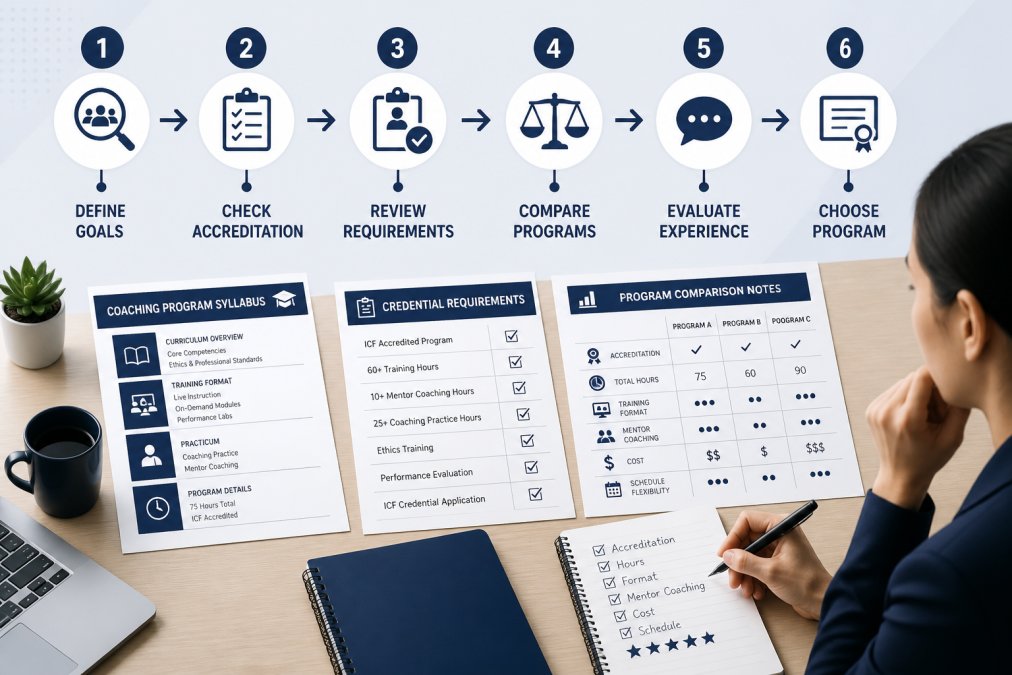
Selecting an ICF accredited coaching program requires evaluating several factors beyond just accreditation status. The best approach is to clarify your coaching niche and professional goals first, then use a structured framework to compare programs against your specific needs.
Step 1: Define Your Coaching Niche and Career Goal
Before evaluating programs, answer these questions:
- What is your intended coaching niche? Are you training to become an executive coach, life coach, marriage and family coach, organizational development coach, or general professional coach? Different programs emphasize different specializations. Imagine Coaching Academy offers three specialization tracks: Certified Executive Coach, Certified Life Coach, and Certified Marriage Coach. Choosing a program that aligns with your intended niche ensures your training is relevant to your practice and your case studies, role-plays, and mentor feedback address real scenarios you'll encounter.
- Is coaching your primary career or a skill enhancement? If you're launching a full-time coaching practice, you need a program with strong business-building support and post-certification community. If you're adding coaching to an existing role (manager, therapist, consultant, ministry leader), you need a program that integrates coaching into your current context.
- What is your timeline to credential and income? Do you need to be credentialed within 6 months, or do you have 12-18 months? This affects which program length and format works best.
Step 2: Evaluate Program Curriculum Against ICF Core Competencies
Request a detailed syllabus from any program you're considering. A strong curriculum explicitly maps to the ICF core competencies and shows how each module develops specific competencies. Look for programs that:
- Cover all 11 ICF core competencies with clear learning objectives for each
- Integrate coaching hours, mentor coaching, and performance evaluation throughout (not just at the end)
- Include case studies, role-plays, and practice scenarios relevant to your intended niche
- Provide feedback mechanisms so you know how you're progressing on each competency
Programs that explicitly map their curriculum to the ICF framework demonstrate intentional design and make it easier for you to track your development.
Step 3: Assess Instructor Qualifications and Real-World Experience
Instructor quality directly impacts your learning. Ask:
- Are instructors themselves credentialed coaches (ACC, PCC, or MCC) with active practices?
- Do they have experience mentoring coaches at the level you're targeting? (An instructor preparing you for ACC should have coached hundreds of hours; an instructor preparing you for PCC should have extensive experience at that level.)
- Can they share examples from their own coaching practice that illustrate the concepts they're teaching?
- Do they stay current with coaching research and emerging methodologies?
Experienced instructors accelerate your learning because they bring real-world coaching scenarios, ethical dilemmas, and practical wisdom to the classroom. They also model the coaching mindset and competencies you're learning.
Step 4: Evaluate the Mentor Coaching Component
Mentor coaching is where you receive personalized feedback on your coaching practice. This is often the highest-impact element of your training. Assess:
- How many hours of mentor coaching are included? Most accredited programs include mentor coaching hours.
- How are mentors selected and trained? Are they credentialed coaches? Do they specialize in your intended niche?
- What is the mentor-to-student ratio? Smaller ratios mean more availability and personalized attention.
- How is feedback structured? Do mentors use a specific framework for evaluating your coaching? Can you access recordings or transcripts of your coaching sessions for review?
- Is mentor coaching continuous throughout the program, or concentrated at the end? Continuous feedback allows you to apply insights immediately.
The quality of the mentor coaching relationship directly impacts your development as a coach. This is worth prioritizing in your selection process.
Step 5: Examine Peer Coaching Structure and Community
Peer coaching, practicing with other trainees, is essential for building confidence and skill. Ask:
- How does the program facilitate practice with other trainees?
- Do you work with the same peer coaching partners throughout the program, or do you rotate? (Consistency builds deeper trust and more meaningful practice.)
- Are peer coaching sessions structured with feedback protocols, or more informal?
- Does the program create a cohort community that extends beyond training? (Alumni networks, peer learning groups, or online communities add long-term value.)
Step 6: Assess Post-Certification Support
Your coaching education doesn't end at graduation. Programs that invest in graduate support create lasting value. Ask:
- Does the program offer continuing education resources for graduates?
- Do they provide support preparing for ICF credentialing exams (ACC, PCC)?
- Is there access to a peer learning community or coaching supervision group after graduation?
- Do they offer business-building resources if you're launching a coaching practice?
- Are there advanced workshops or specialization tracks available to graduates?
Programs that support your journey beyond initial training demonstrate commitment to your long-term success and reduce the isolation many new coaches experience.
Step 7: Compare Format (Online, In-Person, Hybrid) Against Your Constraints
Online programs offer flexibility and accessibility, you can attend live sessions from anywhere and complete coursework around your existing schedule. In-person programs provide face-to-face interaction and immersive cohort experiences. Hybrid formats blend both. The best format is the one you'll actually complete. If you're a working professional with a packed schedule, online delivery removes a major barrier. If you thrive in immersive, in-person learning environments, that format may accelerate your development despite the logistical demands.
Step 8: Evaluate Investment in Time and Money
Compare what you're getting for the commitment. A program that costs more but includes extensive mentor coaching, niche-specific training, and robust post-certification support might deliver better value than a cheaper option with minimal personalized feedback. Consider:
- Total instructional hours and how they're distributed
- Mentor coaching hours included
- Post-certification support and community access
- Whether the program includes business-building or marketing support
- Payment plans or financing options that fit your budget
Quick Niche-Matching Guide
If you're training as an executive coach, prioritize programs with:
- Case studies and role-plays involving organizational dynamics, leadership challenges, and business contexts
- Instructors with corporate or executive coaching experience
- Peer cohorts that include or understand business professionals
If you're training as a life coach, look for programs with:
- Flexibility to explore diverse client goals (career, relationships, health, personal growth)
- Strong foundational competencies in powerful questioning and forward focus
- Community and business-building support (life coaches often rely on referrals and online presence)
If you're training as a marriage and family coach, seek programs with:
- Training in systems thinking and relationship dynamics
- Instructors experienced in couples and family work
- Ethical frameworks for navigating sensitive relationship topics
If you're a faith-based professional (pastor, ministry leader, chaplain, faith community leader) adding coaching skills, prioritize programs that:
- Respect faith-based contexts and values
- Include case studies involving spiritual direction, congregational leadership, or faith community development
- Have instructors or peer cohorts who understand faith-based organizational culture
- Integrate coaching ethics with spiritual or faith-based ethical frameworks
The right program aligns with your niche, your learning style, your schedule, and your long-term coaching vision.
Career Outcomes and ROI After Certification
Understanding what coaches do with their certification and the financial return on your training investment helps you evaluate whether the commitment makes sense for your situation.
Many coaches launch independent practices, while others integrate coaching into existing roles as managers, therapists, consultants, or entrepreneurs.
Coaching as a Primary Career
Coaches can launch independent practices and set their own rates depending on niche, experience, and market. Executive coaches and specialized niche coaches often command higher rates.
Coaches can work towards profitability. Coaches who invest in business-building support during or after certification can enhance their client acquisition strategies.
Coaching as a Career Enhancement
Many professionals use coaching skills to enhance their current role. A corporate manager with ICF training becomes more effective at developing direct reports, often leading to promotion. A non-profit executive director builds stronger relationships with board members and donors. A therapist or counselor can add coaching services to their practice, creating a new revenue stream.
ROI is measured in career advancement, job satisfaction, and higher compensation within your existing field. Coaching certification strengthens credibility and marketability within your industry.
Niche-Specific Outcomes
Your coaching niche significantly affects outcomes and earning potential. Specialized niches, such as coaching for ministry leaders, faith-based organizational development, or executive coaching within faith communities, can offer unique opportunities for coaches who understand their specific context and values.
Corporate coaches often work on longer-term engagements, while life coaches may focus on individual or group coaching.
Timeline to Credential and Income Generation
A comprehensive 125-hour program like Imagine Coaching Academy's curriculum prepares you for ACC credentialing and develops client-ready coaching skills.
Coaches can begin building their client base during or after training. Programs offering business-building modules and post-certification support can assist in this process.
The Intangible ROI
Coaching certification delivers intangible value: greater professional fulfillment, deeper relationships, and increased confidence in creating meaningful change. For faith-based professionals, coaching skills align with core values around service, growth, and helping others reach their potential.
Post-Certification Support and Continuing Education
Your coaching education doesn't end when you complete your initial training. The ICF and most accredited programs offer ongoing resources to support your development.
Continuing Coach Education (CCE) is required to maintain ICF credentials. The ICF requires a minimum number of CCE hours annually to keep your credential current. These hours can come from workshops, conferences, online courses, supervision, and peer learning groups.
Many accredited programs offer continuing education resources to their graduates. These might include advanced workshops on specialized coaching topics, webinars on emerging coaching methodologies, or access to coaching supervision groups. Programs that invest in graduate support create a community that extends beyond the initial certification.
Coaching supervision provides a space to reflect on your coaching practice, process challenging client situations, and deepen your coaching mastery. A supervisor, typically an experienced credentialed coach, helps you examine your coaching approach and identify areas for growth. Many coaches find supervision invaluable for coaching relationships.
Peer learning groups connect coaches for mutual support and continued skill development. These groups might meet monthly to discuss coaching challenges, practice new techniques, or explore advanced coaching concepts. The peer community sustains your growth and prevents isolation if you're coaching independently.
Staying current with coaching psychology and neuroscience research enriches your practice. As the field evolves, new research informs coaching methodology. Programs that help you access this emerging knowledge position you to stay at the forefront of coaching practice.
Coaching certification opens doors to deeper professional impact, whether you're building a coaching practice, enhancing your leadership effectiveness, or serving your community with greater skill. The right ICF accredited coaching program provides the foundation you need to develop genuine coaching mastery. Imagine Coaching Academy's 125-hour program combines live instruction, on-demand learning, and hands-on practice to prepare you for ICF credentialing and a meaningful coaching career. Explore our ICF Certified Coach Training to begin your transformation into a certified professional coach.
Frequently Asked Questions
How long does it take to complete an ICF accredited coaching program?
ICF accredited programs vary in duration based on format and intensity. Most comprehensive programs require between 75 to 125 hours of coach training to meet ICF credentialing requirements. Online programs with flexible scheduling typically allow professionals to complete certification within 6 to 12 months, while intensive in-person formats may be completed faster. The timeline also depends on how quickly you complete coaching hours, observed coaching sessions, and mentor coaching requirements after training completion.
What are the main ICF core competencies for coaches?
ICF core competencies for coaches include establishing trust and safety, coaching presence, active listening, powerful questioning, and creating awareness. Coaches must also demonstrate goal setting and accountability, managing progress and accountability, and designing actions. Additionally, coaches need competency in coaching ethics and professional standards. ICF accredited programs teach these competencies through live instruction, practicum work, peer coaching, and observed coaching experiences to ensure coaches can apply these skills in real-world coaching relationships.
Is an ICF coaching certification worth the investment for busy executives?
For executives and leaders, ICF certification provides credibility, establishes you as a professional coach aligned with global standards, and equips you with coaching methodology that enhances leadership effectiveness. The certification demonstrates mastery of core coaching competencies and positions you for career advancement or launching a coaching practice. Many executives report increased emotional intelligence, stronger team engagement, and improved organizational performance after completing ICF accredited training. The return depends on your goals—whether you're seeking to deepen leadership skills, transition to coaching professionally, or apply coaching principles within your current role.
What are the ICF credentialing requirements after completing a training program?
After completing an ICF accredited coaching program, you must meet ICF credentialing requirements to earn ACC (Associate Certified Coach), PCC (Professional Certified Coach), or MCC (Master Certified Coach) credentials. Requirements include completing your coaching education hours, logging coaching practice hours (typically 60 hours for ACC), submitting a coaching philosophy statement, and passing an assessment that evaluates your coaching competencies. You'll also need continuing coach education units and must adhere to ICF coaching ethics standards. Each credential level has progressively higher requirements for coaching hours and experience before you can apply for credentialing.


